
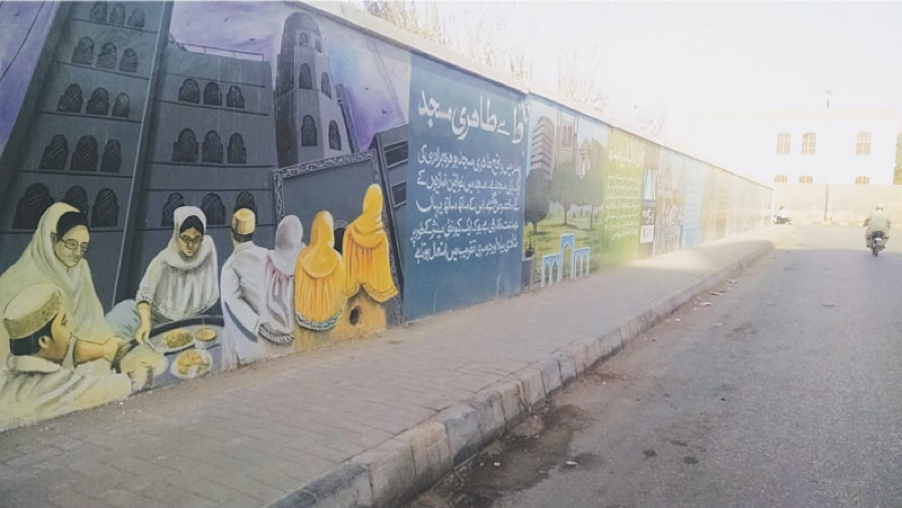
Historically, the walls of Karachi within the public realm have continued to showcase political slogans and messages. They have been used to communicate views against the ruling elite or the despised actions of military establishments.
The walls in Karachi also serve as public notice boards for various purposes. In the late 1970s, when political activities were banned in the country, these walls were relied upon to disseminate political agendas and related information. Because all print and non-print media was under strict censorship by the military rule, wall chalking was used as a mainstream medium of communication. Surprisingly, although these messages were out in the open, they went largely unobserved or ignored by the establishment of the time.
Similarly, wall chalking in the 1980s supported the pro-democracy movement that was secretly initiated. Wall chalking helped organise the struggle for the revival of democracy and mobilised the masses. Thus, these walls played a vital communication role in the pre-digital age.
Photo by the writers
The walls of Karachi have had messages, appeals and slogans written on them related to the exoneration of a former prime minister, support for jailed nationalist leaders and expressions of solidarity with Marxist leaders. Welcome addresses for self-exiled leaders, support for jihad in Afghanistan and messages supporting the release of various arrested local leaders have also found their way on these walls.
These instances lead one to question the extent to which political leaders and those in office benefit from such messages. And if these messages truly go unnoticed or are they simply ignored for larger political gains involved.
Recently, wall chalking has become an even more powerful tool for political activists, despite the dominance of digital media. According to political workers we interviewed, during election times, the walls of Karachi become important announcement boards and a means for communicating different political agendas. The top leadership of political parties also gets involved in the process and walls are carefully chosen to paint different political messages.
There is no question about the effectiveness of this methodology for communicating to the masses. All important political issues are addressed via this method, through carefully thought out phrases, slogans and messages.
The walls are not only used for one-way communication; they are also used for counter messages and political responses. Furthermore, the walls also project messages related to the rights of minority groups, ethical, social and cultural issues, and laudatory remarks for the Pakistan Army and certain political parties.
Broadly speaking, the typology of messages, as documented and analysed by us across the six districts of Karachi, is summarised in Table 1. It is also worth looking into the reasons behind the walls being such prime spots for different sorts of messages.